
Pam MacDonald – Halton Master Gardener
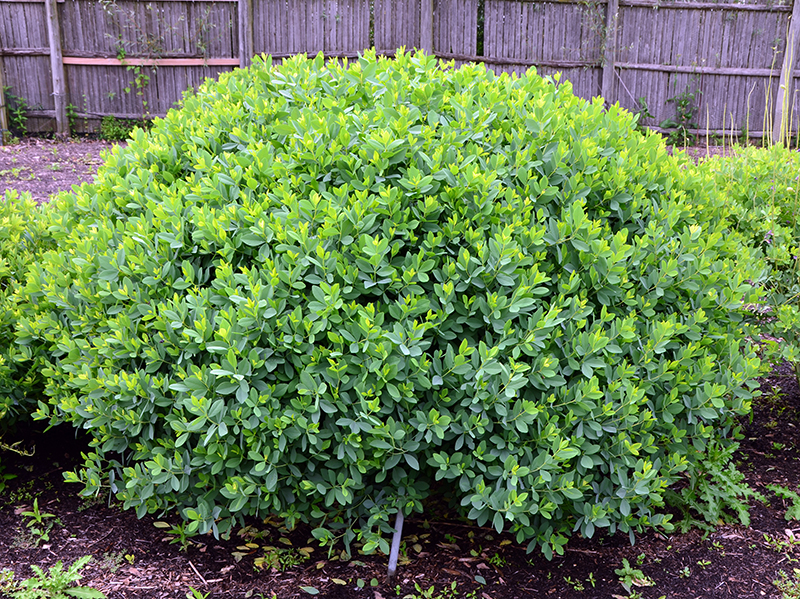
Cover Image: Baptisia australis (blue false indigo) one of the possible options for those replacing boxwood.
Image: Chicago Grows
In the September issue of Cross Pollination, the use and decline of boxwoods was discussed. Gardeners not ready to give up on their boxwoods were offered guidance and pointed to other sources of information on dealing with one of the new issues afflicting boxwoods – the Box Tree Moth.
As Master Gardeners, our focus is on sustainable, environmentally friendly gardening practices. With this in mind, we encourage gardeners who have decided to replace their boxwood to consider native species.
In this article we describe native plants we consider good alternatives to boxwood, plants that bridge the gap between what gardeners want and what wildlife needs. We include native evergreen and deciduous shrubs. Our deciduous recommendations may lose their foliage in winter but they make up for it with other aesthetic and ecological contributions to the landscape.
We also include some herbaceous native plants with a shrubby appearance. Why would we include these? Think of the challenge of clearing snow from driveways or sidewalks hemmed in by woody shrubs or the damage done to boxwoods by salt. Our herbaceous suggestions eliminate these problems. They die back in winter and two of the plants we suggest are salt tolerant.
Boxwood is suited to a broad range of conditions which has been part of its appeal. Substitutes may be more specific in their requirements. For example, plants that call for full sun will not have dense foliage if situated in shade. The foliage of plants that need consistently moist soil, if located on dry sites, may discolour and the plant may defoliate. When choosing your boxwood replacement, remember that putting the right plant in the right place is vital to a happy solution to the Boxwood Blues.
All of our suggested native plants are available at native plant nurseries. Some are also available at garden centres. We encourage you to read our companion article Bee an informed and satisfied consumer – and gardener before you finalize your decisions about what plants to buy and where to buy them.
Ilex glabra (inkberry holly)

Inkberry holly is an evergreen holly native to Eastern North America. In its natural habitat, inkberry holly grows to 10 feet in height and is usually found in wet areas like swamps and bogs. These sun loving plants prefer moist soil; however, they are adaptable and will do well in average garden soil provided they are well watered while they are getting established. Like most other hollies, inkberry is dioecious. Unlike the holly we associate with Christmas, the leaves of inkberry do not have sharp thorn-like spines.
There are several selections of a cold hardy Inkberry native to the maritime provinces and eastern United States suited to the climate of southern Ontario. These selections are more compact than the species. There are also two dwarf cultivars that have been bred to mimic the appearance of boxwood.
Depending on the species of inkberry, the berries may be red, black, orange, or yellow. The berries add winter interest and are a food source at the end of winter for hungry birds. These dense shrubs also provide good winter cover for wildlife. Happily, inkberry is not a first choice of deer to browse and it is not attractive to rabbits.
The berries, for both aesthetic and ecological reasons are highlighted when inkberry is marketed. Be aware that the listed selections are all female and the only confirmed male needed for fertilizing them, ‘Pretty Boy’ is not always available.
Ilex verticillata (winterberry holly)


Winterberry is a multi stemmed deciduous holly native to all of eastern half of North America.
In the wild it is often found in bogs and swamps where it forms large colonies of open, sparsely branched shrubs 10 to 15 feet tall.
In drier soils found in managed landscapes, it is a somewhat shorter, dense shrub with an upright to rounded shape . It can withstand some pruning and the best time for this is early spring, before new growth emerges. This will minimize reduction in berry production the following fall.
Winterberry thrives in full sun. In part shade, it will be leggy and produce fewer berries .It prefers consistently moist soil but can tolerate both poorly drained and dry soils.
Like other hollies it is dioecious. The recommended ratio for best berry production is one male plant to fertilize up to six female plants.
The profusion of brilliant red berries on these shrubs from fall through to late winter, more than compensates for the lack of winter greenery. On a snowy winter day, a hedge or mass planting is a breathtaking sight.
It is widely used in restoration projects for erosion control and for its benefits to wildlife. It attracts more than 40 species of birds. The highly ornamental berries are also appreciated by birds as a source of late winter food. It also provides cover from predators and nesting sites.
There are also many cultivars, too numerous to list here….
Ceanothus americanus (New Jersey tea)

New Jersey tea is a tough, compact plant that thrives in hot, dry, sunny locations. It is adaptable, growing in a wide range of soils and in part shade as well as full sun. Once established, New Jersey tea, will tolerate harsh environments. It is however intolerant of poorly drained, soggy soils where it is vulnerable to root rot.
This shrub generally tops out at 3 feet and is wider than it is tall. It has a tendency to sucker but not aggressively. The suckers can be removed or left to fill in space when it is being used for a hedge or mass planting. New Jersey tea will reach its maximum height and can grow into a dense low hedge in two or three years.
This shrub is particularly useful for low hedges near driveways and side walks. It will not obscure sightlines and it tolerates drought, wind and salt due to its deep, strong roots. It is also an excellent choice to replace boxwood for framing a parterre-style garden.
The delicate white flowers of New Jersey tea are fragrant and long lasting. It blooms in late spring into summer. In the first two seasons when it is small, be sure to protect it from browsing by rabbits with a hardware cloth cylinder. It responds well to an early spring prune to shape and remove any dead branches.
New Jersey tea also has great ecological value. It is a nitrogen-fixing plant, a larval host plant for several butterflies and nectar source for bees. No wonder it was selected North Carolina Wildflower of the Year way back in 2013.
Symphoricarpos albus (common snowberry)

Snowberry is a pretty, delicate-looking shrub that was adopted by settlers and was common in ‘old fashioned’ Canadian gardens until at least the 1950’s. Gardeners of a certain age may recall snowberry from their childhood.
It is a versatile shrub that will grow in sun, part or full shade. It tolerates poor quality soils and a range of moisture from dry to moist. To add to its old-fashioned virtues, snowberry is resistant to drought, pollution and salt.
Sparsely branched, this shrub is airier than boxwood and other substitutes we have suggested. It is suitable for hedging to delineate spaces but will not make a dense privacy hedge. It will grow in full shade but may be too sparse to be of value as a landscape plant in this situation. The height and shape of snowberry can be managed with regular light pruning. This is best done in late winter/early spring to avoid removing flower buds and the resultant berries.
The bright white berries are luminous against the richly coloured foliage and persist into late winter.
As a peek-a-boo hedge described above, or en masse as a tall ground cover in difficult locations, it is much more interesting than a solid mass of green.
In late winter, when food is scarce, many species of birds seek out the berries of this and other plants we have suggested. Though the flowers of snowberry are ornamentally insignificant, hummingbirds and bees are attracted to the nectar.
Hypericum kalmianum (Kalm’s St Johns wort)

Kalm’s St John’s wort is a native of the great lakes’ region, found along sandy and sometimes rocky shores of Lake Huron and Lake Michigan. Growing in the wild it may be a sparse shrub, no more than a foot or two tall. In managed landscapes it will typically grow into a dense mound, 2-3 ft tall. It thrives in full sun and moist to dry, light textured soils. Kalm’s St Johns wort will tolerate part shade but will be a looser, more open shrub with fewer flowers.
This shrub is a stunner with fine-textured blue-green foliage and masses of lemon-yellow flowers in summer. Bumble bees gravitate to this plant for its pollen. They eat the pollen for the protein they need and queens use it to make beebread to feed their offspring. Deer and rabbits, thankfully have little interest in St John’s wort.
Kalm’s benefit from a light pruning after blooming to maintain the size and shape of the shrub. As it flowers on new wood, pruning is best done immediately after the current year’s flowers fade to avoid removing any of next year’s flower buds.
Shrubby St John’s wort is another species of Hypericum found in Ontario,. It is less refined though equally deserving of a place in a sunny garden.
Symphyotrichum oblongifolium (aromatic aster)

This is a compact aster that is as appealing to bees and butterflies as it is to our eyes. If planted near the front of the border, passersby will be wondering what it is, with its fragrant, diminutive foliage. When the flowers begin to open in late summer, it is a ‘stop-the-car’ kind of plant. It’s absolutely covered in blooms over a long period. While lacking any winter interest, it makes up for it in early spring, sprouting up into a mound. As it settles into your garden, it will be wider, than tall—creating a beautiful rhythm particularly in a sloped garden. Aromatic aster is not native to Ontario but is common in the Midwest and northeastern US. Don’t worry, it’s quite hardy for zone 6 in Ontario.

This plant can take tough conditions, but don’t place it in wet soil where the stems will get floppy. Full sun, part-sun, clay, sandy or rocky soil are no problem at all.
To keep the size compact, pinch it back twice in mid to late spring, dependent on the growth.
Baptisia australis (wild blue indigo)
Though the native range of this plant does not include Ontario and its time and mode of migration here unclear, it is valuable to Ontario wildlife and grows well with native plants. Maybe it slipped across the border on the Underground Railway or with the Empire Loyalists!

Wild blue indigo thrives in full sun in well drained soils. In part shade it will become floppy.
For the first year or two, this plant will have few stems and no flowers. It is busy putting down a deep tap root that will set it up to thrive in hot dry conditions and tolerate harsh environments. As a mature plant, it will rise each spring from its woody base to form a vase shaped mound of blue-green leaves topped with spires of blue, sweet pea-like flowers. Wild Blue Indigo maintains a pleasing shape after flowering and can be trimmed as needed to maintain the desired size until the plant goes dormant in the fall.
Like other members of the pea family, to which it belongs, Wild Blue Indigo is nitrogen-fixing and will add nitrogen to the soil as it grows. Its early blooms are a welcome source of nectar for queen bumblebees waking from winter hibernation. It is also a larval host to several species of butterflies and moths.
Thuja Occidentalis (white cedar)

Thuja occidentalis, better known as eastern white cedar, is an evergreen tree native to Eastern North America. Another name for Thuja is arborvitae which means “tree of life’. ‘Emerald’ Eastern white cedar are ubiquitous hedges and privacy screens. Many bird species appreciate the shelter and nesting sites these trees provide.
There are many compact and dwarf Thuja cultivars. They bear little resemblance to the species. They have been bred to fill the demand for smaller evergreens, however in the process they have lost their ecological value.
Consult the attached table for some locally available Thuja occidentalis cultivars.
All of these cultivars prefer full sun and moist to medium soil. They are all slow growing. Nonetheless, when planting any of them, keep in mind the mature size. As with boxwood, regular light pruning will ensure they keep their shape. The exception is ‘Mr. Bowling Ball’ which requires no pruning to maintain its shape.
Taxus (yew)

While there is a Taxus species (Taxus canadensis) native to Ontario, it is a low groundcover and at this point in time not widely available in the horticulture trade. The yews suitable for replacing boxwood in our region are non-native species. The most suitable of these, as a replacement for boxwood, is Taxus cupidata ‘Nana’ Dwarf Japanese Yew.
Yews grow in sun or shade, preferring slightly acidic, well drained soils. They are intolerant of wet, poorly drained soils which will lead to root rot. They can be pruned to control size and shape. Early spring is the best time for pruning.
Itea virginica (Virginia sweetspire)

Itea is an adaptable shrub from south of the Great Lakes that offers beautiful texture, fragrant spring flowers and fall colour, while at the same time being a source of nectar in spring.
While the species prefers acidic, moist soil and partial shade, the cultivars can thrive in clay, sandy soil and full sun if provided enough moisture to become established in your garden. The slender, arching branches provide beautiful texture and the foliage turns to a bright red to maroon colour in autumn. While almost the ‘perfect’ shrub as an accent, border or foundation planting, it does have one drawback. It tends to sucker. The suckers emerge from the root system and can develop into a colony over time if not removed as they appear. Suckering is more common in rich soils rather than dryer, heavy soils.
The cultivars offer a more compact shrub and sometimes variation in leaf tone and fall colour. If grown in full sun, this plant will develop a more dense structure than an area with less light. Did I mention that it’s also deer resistant and drought tolerant once established?
BOXWOOD ALTERNATIVES
Cover Image: Baptisia australis (Chicagoland Grows)

 Halton region Master Gardeners
