


‘Beauty is in the eye of the beholder’, but sometimes there are other forces at play. Municipal bylaws and neighbour complaints can result in conflicts sometimes leading to garden plants being removed and fines levied. Many of us have listened to speakers such as Lorraine Johnson, Douglas Tallamy, or our own Claudette Sims and Catherine Kavassalis (Halton Master Gardeners and founders of CCIPR – Canadian Coalition for Invasive Species Regulation), about the crisis in biodiversity, loss of habitat and the effects of climate change. We are asked to change how we garden, include native plants for critically endangered species and care for our landscapes as though they were part of the natural areas beyond our garden. We’re eager, we’re ready but, we wonder, are we allowed? No one wants to be met with the bylaw officer examining our garden. Perhaps you’re also thinking, “How will my neighbours feel about this type of garden?” Maybe you’re more of the mind that you want to make a statement in spite of these possible roadblocks.
The good news is that things are changing. Municipal bylaws are slowly catching up to the science behind transforming your garden into a biodiverse oasis. Conventional neighbourhoods no longer have only vast expanses of turfgrass. This is in large part to organizations such as Burlington Green, Green Venture (Hamilton), and individuals such as Doreen Nicoll in Burlington (article to left) speaking up and working together with municipal officials to make changes. Hamilton is now a ‘Bee City‘, and resources such as the Hamilton Pollinator Paradise Project and Butterfly Way Hamilton support gardeners as they transition their landscapes. There is even recognition for ecological gardens through The Monarch Awards in the City of Hamilton.
Where Are Municipal Bylaws Now?
Here’s an overview of some of the pertinent bylaws in our local communities. This post focusses on the Cities of Hamilton and Burlington (next, Oakville and Milton) .
City of Hamilton:
- Pertinent Bylaw: By-law No. 10-118 being a by-law to regulate exterior Property Maintenance, including vegetation, vegetation waste and graffiti.
- Every owner or occupant of property shall keep vegetation in the yard of their property clean and cleared up.
- If located inside the urban boundary that is equal to or less than 0.4 ha in area, to keep all plants cut to a height of equal to or less than 21 cm, except:
- ornamental plants;
- shrubs or trees;
- cultivated fruits or vegetables;
- plants buffering or otherwise protecting a natural feature such as a watercourse;
- If located inside the urban boundary that is equal to or less than 0.4 ha in area, to keep all plants cut to a height of equal to or less than 21 cm, except:
- to remove all noxious weeds (open the link to see the list)
I think this bylaw allows for a great variety of gardens within the City of Hamilton. It means that all plants, except those on the noxious weed list, can be included in a garden landscape. Homeowners do, however, need to take care and weed out the undesirable weeds on the list from OMAFRA .
Tamara Reid, Supervisor of Operations and Enforcement for the City of Hamilton, stated in 2018 for the Hamilton Pollinator Paradise Project that:
“…demonstrating intention is key. It is helpful to have even a hand-drawn image of what you are aiming for–what your garden is intended to look like. You can show that to a by-law officer and that helps.”
Tamara Reid, City of Hamilton 2018
Tamara suggests having some visual demarcations like logs or rocks, different heights of grasses or plants, to help guide the eye so that the garden looks planned. Including borders, (i.e. using the same plant repeatedly or using an edging material) helps a garden look purposeful and organized.

Note to Self
Create a drawing of the garden
- Include:
- plants of different heights, groupings or masses of the same plants together or along an edge
- add focal points, decorative pieces (e.g., logs, rocks, sitting area, bee bath, water feature, garden art)
- access through paths
- Have a defined buffer zone next to public areas or neighbours’ property (e.g. low-growing native plants, stone or a strip of turf grass)


Intention is key: Examples in the gallery above include defined pathways, ‘buffer zones’ next to public spaces and low-growing native plants.
In the city of Burlington, the Lot Maintenance Bylaw was updated recently (2019) after several confrontations with bylaw officers visiting homes with naturalized gardens, and after having received complaints from neighbouring properties. The mayor has addressed the updates on her webpage (Mayor Marian Meed Ward). There appears, however, to be some confusion between the mayor’s comments and the new bylaw. Specifically, this quote from the mayor’s webpage:
There are numerous examples across the City of naturalized lawns where no enforcement action is taken due to the manner in which the lawns are carefully grown, maintained and cared for and where a buffer strip is maintained.
Mayor Marianne Meed Ward, City of Burlington, Ontario Canada
The City’s bylaw defines a “buffer strip” as cutting all grass and ground cover within three (3) feet of any adjoining property line. Similar bylaws exist across municipalities within Ontario
However, in the actual by-law it states that a buffer strip is only required on larger properties (greater than 0.4 ha). The wording in the by-law is what residents should follow.
In addition it’s noted that in section 5.1, residents are advised to:
5.1 …maintain the lot on their property free from any nests of bees, wasps, hornets, rodents, vermin, insects or other pests.
Really…bees and insects? Have they not read the news recently? I know people don’t enjoy ‘vermin’, wasps or hornets, although they do exist everywhere and have a purpose in most settings. I’m sure it was just a ‘blanket statement’ from years ago that was overlooked in this recent review. Insects such as bees, are exactly why most of us have begun to include naturalized gardens in our landscapes. I’m sure given time, the wording will be updated.
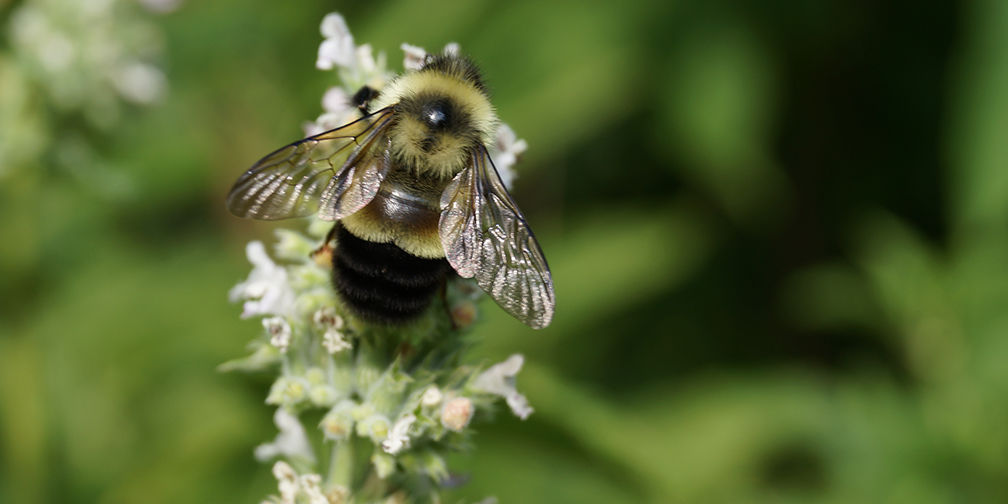
Read more about Ontario’s endangered bees at Ontario Nature
Here’s a summary of Burlington’s by-law.
City of Burlington
- Pertinent bylaw: By-Law 49-2022. A by-law to Repeal and Replace Lot Maintenance By-law 59-2018, being a By-law to Regulate Exterior Property Maintenance including Vegetation, Refuse and Graffiti.
- Cut vegetative growth on the boulevard whenever the height of the vegetative growth exceeds 20 centimeters in height or length and shall keep the boulevard free of all noxious weeds. (3.6)
- Every owner of property shall remove and destroy all noxious weeds, whether dead or alive, from their lot. (3.7)
- Vegetative growth shall not:
- obstruct sidewalks or streets;
- vegetative growth shall not conceal or interfere with the use of any fire hydrant or water valves;
- vegetative growth shall not restrict driver and pedestrian sight lines at intersections, driveways, sidewalks, walkways, or visibility to all traffic control devices;
- any other conditions respecting health and safety as the Director considers advisable.
- The following definitions are provided within the bylaw
- “naturalized area” means an area or vegetation deliberately planted or cultivated with one or more species of wild flowers, shrubs, annuals, perennials, ornamental grasses, or combination of them, that is monitored and maintained by a person
- “vegetative growth” means woody or herbaceous plant material such as undergrowth, grass, brush, and common weeds (such as crab grass, dandelions, clovers, pigweed (amaranth), ribwort plantain, and buckhorn plantain) and includes various perennial grasses grown for lawns, of a type that forms a dense, uniform turf if mown;
- “ornamental plants” means a plant deliberately grown for beautification, screening, accent, specimen, colour or other aesthetic reasons but does not include vegetative growth as defined in this by-law.

Note to self:
- Keep groundcovers less than 20 cm. This includes plants such as non-ornamental grasses, clover etc.
- Ensure that plants do not obstruct the view for safety between vehicles, cyclists and pedestrians near driveways, roads and sidewalks.
- Keep public areas such as sidewalks free from plants (i.e., plants are not flopping onto the sidewalk or your neighbour’s garden).
- Plan for access open to hydrants or the water valves.
- Double check OMAFRA‘s list of invasive plants and make sure they’re removed regularly
Here’s an infographic I created that may be helpful to you in transforming your landscape to a naturalized garden that will add biodiversity and habitat. It includes 8 basic principles to guide gardeners.
- Add structure with woody trees & shrubs, native of course! Choose a variety of native perennials, planting in large groupings, drifts and masses.
- Create a sitting area with chairs, log bench or boulders.
- Use repetition to build unity, bringing the space together. This can include species, colours or shapes.
- Create a ‘buffer’ zone near public areas, like sidewalks and neighbours. Low-growing plants or a strip of turf grass can be effective choices. Keep the height under 2’ for ornamental plants and under 8″ for turf, to ensure clear sightlines for safety. Don’t use ‘flopping’ plants.
- Add a sign (or signs) to show your garden has a purpose.
- Add ornaments, logs, rocks, sculptures – be creative.
- Choose plants with seasonal interest. Colour for fall, berries or bark for winter, and blossoms in spring. Be sure to include some evergreens and grasses for winter.
- Add pathways—it will help with maintenance and gives the garden shape.


 Halton region Master Gardeners