
Claudette Sims – July 14, 2025
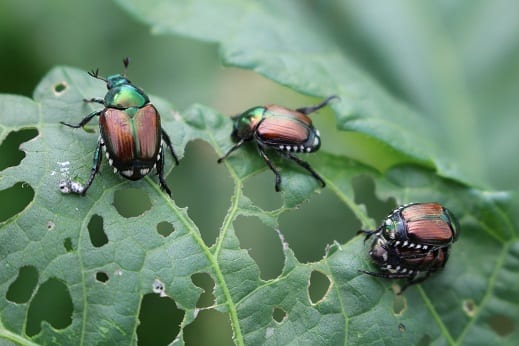
As many gardeners know, Japanese beetles (JBs) are active from July through August. This invasive insect species feeds heavily on trees, shrubs, flowering plants, and edibles. Healthy, mature trees and shrubs usually tolerate damage well, but flowering plants may lose blooms, and fruit or vegetable yields can drop with heavy feeding.
Avoid spraying pesticides.

Usually only 1 or 2 WF eggs are laid per JB; however, when host density is low, higher egg-lay can – Image: Univ. of Minnesota Ex.
These products harm beneficial insects such as the Winsome fly (Istocheta aldrichi) and Tiphia wasps (Tiphia vernalis and T. popilliavora), both important JB predators. Look for beetles with small white eggs on their backs—those are doomed thanks to Winsome fly parasitism. T. vernalis larvae attack overwintering grubs, while T. popilliavora larvae target late summer grubs. Support adult wasps by maintaining aphid populations on cherry, maple, and tulip poplar foliage as a food source.
Ground beetles (Carabidae) also prey on JB grubs. Creating beetle banks—undisturbed mounds planted with native grasses and perennials—offers critical habitat for these predators. Other natural enemies include Robber Flies and Assassin Bugs.
View this video:

Management Tips
- Start early to limit population growth.
- Hand-picking: Knock beetles into soapy water or use a hand vacuum. Do this in the morning or evening when beetles are sluggish. Evening collection reduces recolonization. Craft a collecting scoop for convenience.
- Barriers: Fine mesh or row covers can protect vulnerable plants.
Grub Control
Killing lawn grubs will not eliminate adult beetles, as they often fly in from surrounding areas. Broad-spectrum grub treatments also harm beneficial insects such as fireflies, whose larvae keep snails and slugs under control. Better approaches include reducing turf area, mowing high, and watering deeply but less frequently.
Choose gardening practices that support biodiversity and integrated pest management. A balanced garden tolerates some feeding while supporting healthy ecological relationships.
Resources
- Government of Ontario: Managing Japanese Beetles without chemicals
- Government of Canada: Popillia Japonica (Japanese Beetle) – Fact Sheet
- Japanese beetles in yards and gardens – University of Minnesota Extension
- The Winsome Fly – A biocontrol agent for Japanese beetle
- Video: Spotlight on Research: Hand-removal of Japanese beetles
- Protecting Fireflies from Pesticides – Xerces Society
Cover Image: University of Kansas

 Halton region Master Gardeners