

Cathy Kavassalis Halton Master Gardener
July 31, 2025
Many gardeners grow milkweed (Asclepias spp.) to support monarch butterflies. It’s a great idea, but it’s only one reason to include milkweed in your garden.
Milkweeds have much to teach us about evolution, relationships, and ecosystems. With over 140 species stretching from Canada to South America, these plants have adapted to deserts, meadows, and wetlands. Some have leaves cloaked in hairs or glandular trichomes to modulate temperature, reduce water loss, reflect light, and discourage hungry insects. Others wear waxy, water-repellent coats that help prevent fungal spores from germinating. All produce some kind of toxic latex—a sticky chemical cocktail rich in cardiac glycosides. It deters most, but not all, would-be diners. Over time, a remarkable community of specialist insects has evolved not just to tolerate milkweed’s toxins, but to depend on them.
Life on a milkweed can be fragile and brief.
Curious about the visitors to my milkweed patch in Seguin, I took a closer look, focusing on just common milkweed (Asclepias syriaca). What I saw over the course of a few days astonished me.
Visitors and Interactions

A tumbling ragdoll beetle, likely Mordella marginata, surprised me as it moved across the leaf and hovered over spots of sap. When disturbed, it indeed tumbled. What was it doing there? I’m not sure. Its larvae are saproxylic, dependent on polyporous fungi that break down wood.
Nearby, tiny black beetles skittered across the leaves. At first, I thought they were the pollen-feeding shining flower beetles (Olibrus spp.) I’d seen on my Joe-Pye weed. But these were behaving differently. What were they doing? I decided they might be shining mould beetles (Phalacrus spp.) grazing on yeast or fungal threads growing where insect excretions or plant sap had collected.
Speaking of excretions, I found a colony of dogwood-milkweed aphids (Aphis asclepiadis) producing honeydew for their attending ants. I was nipped by one diligent guard as I leaned in for a photo. These ants aggressively defend their colonies from would-be competitors. Other ants and insects steer clear. It’s a cool symbiotic relationship to witness.
Among the leaves, I found a teddy-bear of a lady beetle (Brachiacantha ursina), a lacewing egg perched on a filament stalk, and spined soldier bugs hunting through the foliage.


I wondered—had the milkweeds called to them for help through chemical signals?
I was gobsmacked by a walking fuzz ball, which I came to discover was the larva of a stripe-horned green lacewing in the family Chrysopidae. I had seen a brown lacewing in a spider’s web and its distinctly different dragon-like larva eating aphids (family Hemerobiidae). I had no idea there was such a range of lacewings.
Equally mesmerizing was a shimmering green midge (Stenochironomus spp.) waving its improbably long front legs in the breeze. I think it was just resting in the shade. The adult stage of this small fly is short-lived and primarily focused on reproduction. Plants sometimes just provide refuge.
Monarchs and milkweed tussock moth caterpillars were both present. Monarchs were few. Tussocks congregate. A large mass of caterpillars can thwart some would-be predators, but I witnessed hundreds disappear overnight. Life on a milkweed can be fragile and brief.
Over the course of a few days, I observed dozens of creatures feeding, hiding, hunting, and reproducing. Some interactions were clear. Others were beyond my understanding.
A Living Community
It’s worth noting that planting too much of a single species in a dense patch can have unintended consequences. Concentrations of milkweed can make it easier for predators to find monarch caterpillars, or for aphids and diseases to flourish. A bit of randomness, more patchiness, can help tip the odds in favour of monarch survival.
When you plant milkweed, you are inviting a diverse community to develop. This is life. Here’s wishing you the joy of witnessing it unfold as you create gardens that foster connections.
A Gallery of Life on Milkweed


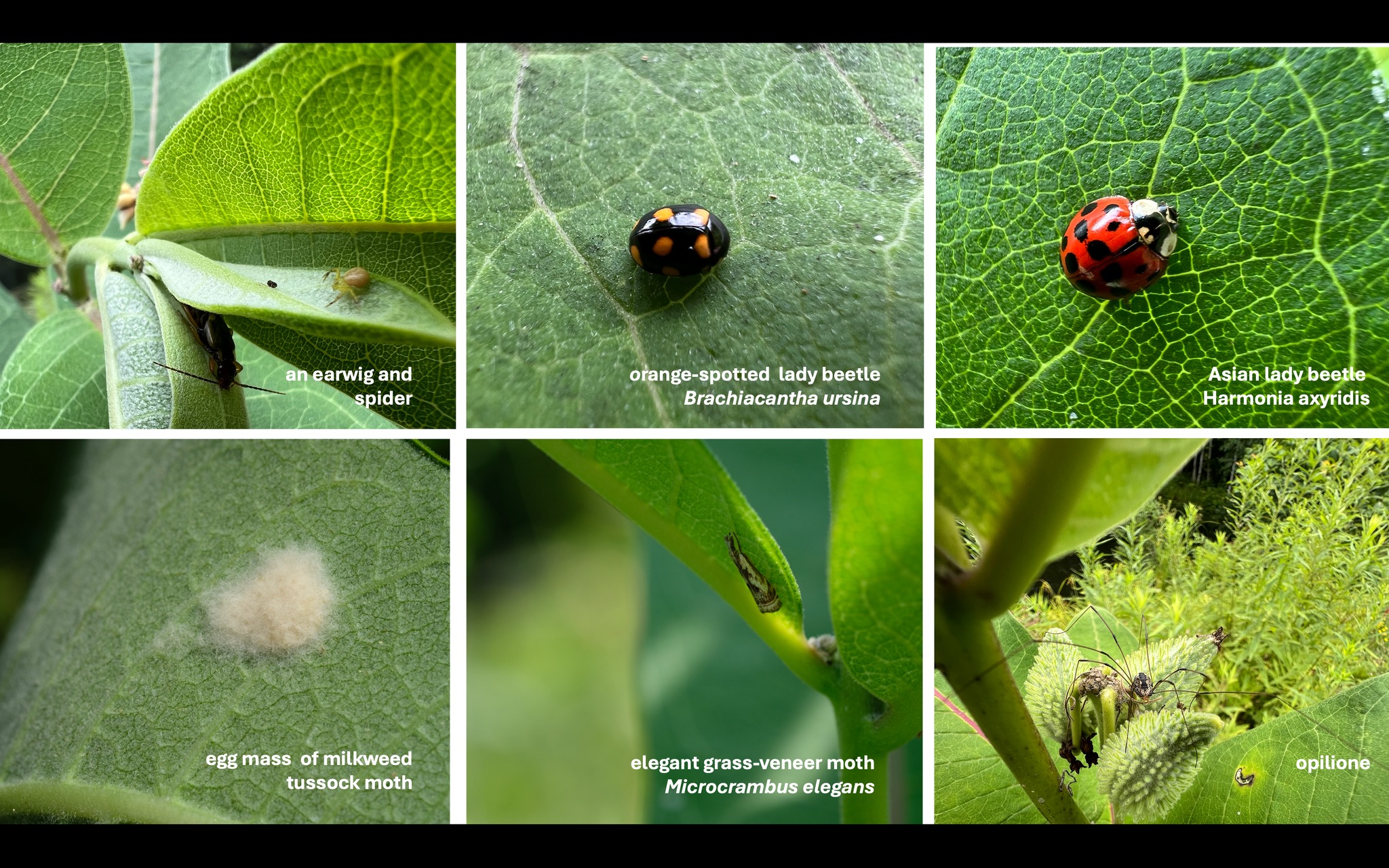
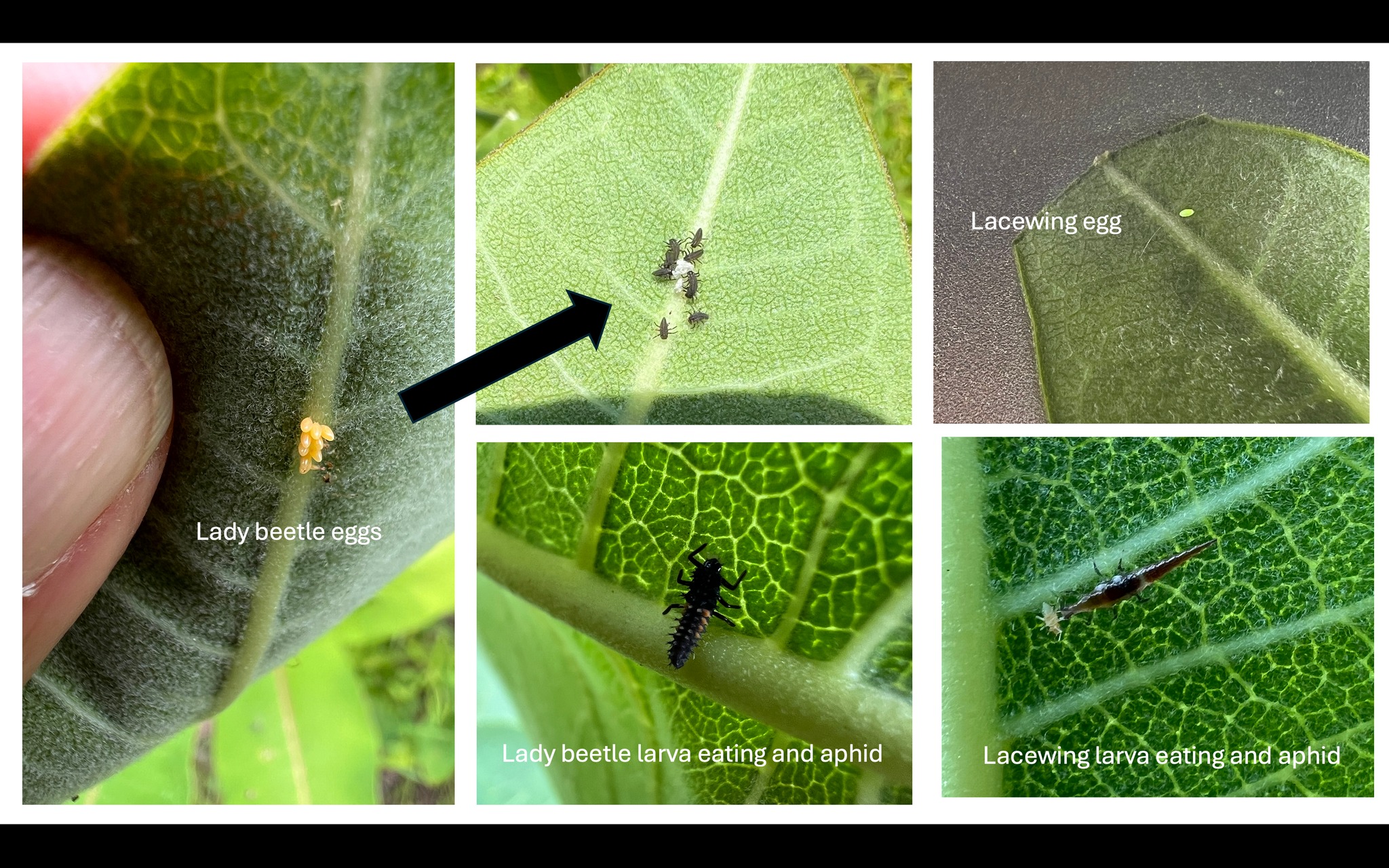

Description of Gallery – (clockwise from top left): 1. It’s worth noting that planting too much of a single species in a dense patch can have unintended consequences. Concentrations of milkweed can make it easier for predators to find monarch caterpillars, or for aphids and diseases to flourish. A bit of randomness, more patchiness, can help tip the odds in favour of monarch survival. 2. Monarchs and tussocks were both being heavily predated. Here today . . . gone the next. 3. From hunting long-legged flies to resting dragon flies, there was constant change. 4. Butterflies and bees on the flowers – most flowers were done 5. The fuzzy stuff consists of plant hairs: “Larvae carry a debris packet of plant trichomes.” https://bugguide.net/node/view/341460…. 6. I spotted the eggs one day and when I checked again they had hatched. 7. Lady bugs, moths, spiders . . .
View Video of:
- Stenochironomus (a genus of non-biting midges) https://en.wikipedia.org/wiki/Stenochironomus
- brown lacewing larva
- Striped-horned Green Lacewing (Ceraeochrysa lineaticornis) https://bugguide.net/node/view/341460
📚 Further Reading
- Boggs, Joe. 2022. Oleander aphids and monarchs. Buckeye Yard & Garden Line (OSU Extension)
- Borders & Lee-Mäder, 2014. Milkweeds: A conservation practitioner’s guide, Xerces Society
- Dailey, Graves, & Kingsolver. 1978. Survey of Coleoptera on milkweed. The Coleopterists Bulletin
- Price & Willson. 1979. Herbivore abundance on milkweed. The American Midland Naturalist
- Rasmann et al., 2009. Cardenolides and induced responses in milkweed. Ecology



 Halton region Master Gardeners