
Cathy Kavassalis – Halton Master Gardener
August 30, 2025
Canada’s Plant Hardiness Zones Updated
Natural Resources Canada has released the first update to Canada’s Plant Hardiness Zone Maps in over a decade, based on 1991–2020 climate data.
Key Facts
- Canada’s system is different from the USDA’s.
These seven together generate a suitability index that’s then divided into hardiness zones (0 to 9, with “a” and “b” subzones).
- Since 1961–1990, most of Canada has warmed by ½ to 2 full zones.
- 99.6% of changes were increases, though a few small areas (e.g., parts of Newfoundland, Vancouver Island, Prairies, and northern Quebec) saw decreases.
The biggest drivers of change were:
- warmer winters
- longer frost-free periods
- hotter summers.
Ontario Highlights
- The GTA (Greater Toronto Area) is Zone 7a.
- Ottawa has changed only slightly and remains 5a.
- Saute St. Marie is Zone 5a.
- Windsor is Zone 7b.
👉 Check your nearest municipality here

Gardening Implications
Warmer temperatures and longer seasons may allow for extended harvests and for growing a greater variety of fruits and vegetables, but drought, heavy rains, and false springs mean gardeners will face increasingly unpredictable conditions.

Invasive Species and Caution
- Be aware that invasive plants, pests and diseases will have new opportunities to spread.
- Use caution when adding new plants, soils, or mulches to your garden.
- Always check a plant’s invasive potential before choosing new introductions (type the botanical name + “invasive” into your search engine).
- Be careful not to move invasive species between areas (movement of plants, wood, soils/mulches, and indirectly on boots & vehicles).

Comparing to US Grow Zones:
Here is a map that looks at the lowest extreme temperature. This allows us in Canada, to compare our gardens to to those located in the United States.
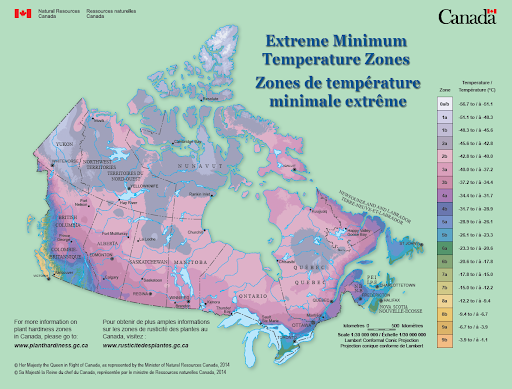
View More Here About the US and Canadian Zones
Further Reading
- Updated plant hardiness zones for Canada and assessment of change over time. Sci Rep 15, 22774 (2025), McKenney, D.W., Pedlar, J.H., Lawrence, K. et al., Nature
- Canada’s Growing Zones Are Changing 2024 – Gardening In Canada: Using science In the Garden
- Citrus Trees in Canada – CBC
- Predicted Effect of Climate Change on the Size ($) of the Climate Habitat of 130 North american Tree Species – Natural Resources Canada
- Species- Specific Models & Maps – Natural Resources Canada

 Halton region Master Gardeners