Allyn Walsh
March 2, 2025
Benefits
Gardeners are increasingly aware of the many ecological benefits from adding native plants to their gardens and now there is a emerging trend of using native perennials in container gardens. They want their gardens to be beautiful but also want them to offer food and shelter for the many native insects and birds that are so important for human survival. Container gardens are the perfect choice for many. Let’s explore planting native plants in containers.
Containers Can Be a Solution
Limited Outdoor Space: You don’t need a large expanse of land to help support our ecosystem. Many people have only a small outdoor space such as a courtyard, patio or a balcony. Some live in rental accommodation and do not want to invest large sums in a garden that may be temporary. A container doesn’t take up much space and can be moved.

Reduced Time or Mobility: Containers are also ideal for those with only a little gardening time each week. Additionally, they benefit individuals with strength and mobility issues, requiring less bending and lifting. Weeding and digging requirements are very small compared to an in-the-ground garden.
Involving Children in Gardening: Containers are also a fun way for children to start gardening. The growing plants are readily visible and are easily planted by little ones.

Opportunity to View Plants & Pollinators: Those with large properties will enjoy having containers near their outdoor sitting areas since they will be able to see the plants and pollinators close up.
Choosing the Right Container
- Size Matters: Unlike annuals which are often used in containers, native perennials have extensive root systems which need space.
- The larger the container the better
- A container at least 20 inches (50 cm) in diameter and 15 inches (40 cm) deep is recommended.
- Plants also show healthy growth with a little space between them.
- Plants may be kept in the same container for years allowing for growth over time.
- Smaller pots can work if plants will be transplanted at the end of the growing season.
- Make sure there are adequate drainage holes to prevent root rot.
- The larger the container the better
- Winter Considerations: Some containers can stay outside, but terracotta, clay, and ceramic may crack when wet material inside freezes.
- Insulating containers or placing them in a sheltered area (i.e., garage or shed) can help
- fiberglass, stone, or plastic options are best for winter durability.


Images: The Laidback Gardener
Proper Placement of Containers is Essential
Winter Damage: Plants can suffer damage due to the freeze / thaw cycle or intense sunlight in winter. Containers get much colder than soil in the ground. Most of the plants recommended below will do fine during their winter dormancy especially if containers are clustered together in a spot sheltered from the winter sun and wind. You may want to consider adding an insulating layer of mulch or fallen leaves tp the soil surface.
Light is an Important Consideration: As with any planting, it is important to assess available sites. Choose plants best suited to the available conditions. A prime consideration is light, both the sun’s intensity and timing. The level of moisture and growing media is controlled by the gardener. Investigate potential plants thoroughly ahead of time, noting their preferred conditions. There is nothing wrong with a little experimentation but the closer to preferred conditions the greater likelihood of success.

Avoid Mixtures with Fertilizer: When selecting growing media for native plant containers, remember that they have evolved for our climate and soil conditions. Many will not flower well in a richly fertilized medium – but you will get a lot of leaves. Native plants have evolved for the conditions here in southern Ontario. That tends to mean many don’t do well in heavily fertilized growing media: they prefer lean soils. Investigation of the plant’s preferred soil is important. It is very easy to modify soil in containers, unlike garden beds. An example is growing low-bush blueberry in a container if you live in soils that are alkaline such as those in southern Ontario. Blueberries require acidic soils. While it is possible to add a material to the garden to lower the pH, this would need to be done with great frequency. In a container, you can choose an acidic soil mixture that will help your blueberry shrub thrive.
Soilless Mixtures are Best: Soil from your garden isn’t suitable – as well as being quite heavy, it compacts in containers. Use a soilless potting mixture – and for ecological reasons consider avoiding the use of a peat-based mix. Plants remaining in the container over time will use up the nutrients however, adding some organic fertilizer will perk them up. Adding compost is easy and beneficial. Many recipes to make your own potting media are available online. Finally, it is recommended to change the soil every few years as some mineral salts can build up over time.
Choosing the Right Growing Medium
Planting and Caring for Native Plants in Containers
Planting techniques are the same as with any container garden.
- Ensure that the growing medium is damp all the way through, but not sopping wet.
- Dig a hole so the plant goes in at the same depth it was in its container or the ground.
- Transplanting is best done on a cloudy, cool day since small roots can dry out very easily.
- If seeding plants right into the container, seeds should be placed at the depth recommended for the plant.
- Some native plants will self-seed and this can be another method of winter sowing.
- Be sure to place plants allowing space for growth. Container plants are expected to be more crowded and smaller than they would be in the ground.
Inappropriate moisture levels are probably the most common cause of failure in container gardening. Plants cannot depend on rainfall as containers dry out much more quickly. At the same time, overwatering is the kiss of death to container plants outdoors just as it is to houseplants.
- Check containers frequently and water according to the moisture level, not by a schedule. Continue watering late into the fall until the soil is frozen.
- NOTE: If combining different species in a container, they should all tolerate the same moisture levels, light conditions and growing medium.
- Drainage is key when overwintering plants in pots. In spring as the pots thaw out, the ensuing wet can rot the roots.
Deadheading blooms will keep the container looking organized, discourage unwanted self-seeding, and for many plants encourage more flowering. Although if you want to feed the birds, seedheads left at the end of the season may be a welcome feast. It’s beyond the scope of this article to discuss the ins and outs of deadheading as it varies so much by species – but it’s important to know this for any of your container plants to ensure their best performance. As you would in the garden, plants should be inspected to remove any diseased or damaged parts.
Selecting the Right Native Plants
Which plants you decide to plant in your containers depends very much on how you want them to function. Native plants used in containers are almost all perennials and can stay in place for years. But as they grow and self-seed, you may wish to transfer some into the ground.
Consider Looking to Your Garden: You may be interested in moving some seedlings from a ground garden into a container. This can be for a single season or on an ongoing basis.
Plant Selection: All the native plants from your ecoregion / district will benefit the ecosystem. However, some are much more of a pollinator or bird magnet than others. If watching wildlife at work is important to you, you should select plants accordingly.
Plant Design: Do you want to mix different species in a container, or would you prefer to have a single species per pot? The latter is the easiest option, but it can be fun to plan a thriller, filler and spiller look with different species. Remember though, to make sure the conditions available (primarily light and moisture) work for each of the plants.


Images: Native Plants in Containers (The Garden Diaries), Container Gardening with Native Plants
Blooming: Native perennials tend to have shorter bloom times than plants specifically bred to bloom for a longer period of time, or than annuals. Planning is needed to make sure there is a sequence of blooms. Such a sequence is visually attractive. It is also helpful for pollinators to have a source of food over the entire growing season.
Foliage: It isn’t all about the flowers when it comes to appearance. Consider plants that have attractive foliage throughout the seasons and combine them with the usual consideration of colour, texture, and form.

Pennsylvania Sedge (Carex pennsylvanica) Image: I. Wallace 
Pickerel weed (Pontederia cordata), water lilies (Nymphaea ordorata), soft rush (Juncus effusus) in a water garden: C. Davitt 
Columbine (Aquilegia canadensis), Ostrich fern (Matteuccia struthiopteris), and Virginia knotweed (Polygonum virginiana) Image: M. Wallce 
The beauty of Dogbane’s foliage (Apocynum cannabinum) Image: C. Davitt
Images: Grow Native
The more native plants that are used the better, but it is still acceptable to have some non-native plants included if they are not invasive. As long as most of the plants are native to your ecoregion / district, you will be benefiting the ecosystem.
Researching Native Plants for your Region
- Look for plant lists specific to your ecoregion to ensure successful growth.
- Experimenting with different species is part of the gardening experience.
- Many online resources provide detailed guidance for various North American regions.
Using native plants in containers is an effective way to support biodiversity while enjoying a beautiful and low-maintenance garden. With some planning and care, container gardening can be a rewarding addition to any space.
Do consider using native plants in containers. Like any new gardening technique, investing up front in some reading and planning will pay big dividends.
| Botanical Name | Common Name | Light | Moisture | Design |
|---|---|---|---|---|
| SPRING Blooming | ||||
| Geum triflorum | Prairie smoke | Part Shade-Sun | Moist-dry | Filler |
| Geranium maculatum | Wild geranium | Shade to Sun | Moist-dry | Spiller |
| Aquilegia canadensis | Wild columbine | Shade-Sun | Moist-dry | Filler |
| Tiarella stolonifera | Foamflower | Shade-Part shade | Moist | Filler & spiller |
| Penstemon hirsutus | Hairy beardtongue | Shade-Sun | Moist-dry | Filler & Thriller |
| Sisyrinchium angustifolium | Blue eyed grass | Part shade-Sun | Wet-medium | Filler |
| SUMMER blooming | ||||
| Allium cernuum | Nodding onion | Part shade-Sun | Moist-medium | Filler |
| Anaphalis margaritacea | Pearly everlasting | Part shade-Sun | Medium-dry | Filler |
| Coreopsis lanceolata | Lanceleaf coreopsis | Sun | Dry | Thriller |
| Rudbeckia hirta | Black-eyed Susan | Part shade-Sun | Moist-dry | Thriller |
| Verbena stricta | Hoary vervain | Sun | Medium-dry | Thriller |
| Heliopsis helianthoides | False sunflower, oxeye sunflower | Part shade-Sun | Moist-dry | Thriller |
| Monarda spp. | Bee balm | Part shade-Sun | Variable | Thriller |
| FALL blooming | ||||
| Symphyotrichum oolentangiensis | Sky blue aster | Part shade-sun | Medium | Thriller |
| Solidago caesia | Blue-stemmed goldenrod | Part shade-sun | Medium | Thriller |
| Agastache nepetoides | Yellow giant hyssop | Part shade | Medium | Thriller |
| FOLLIAGE Fillers | ||||
| Polystichum acrostichoides | Christmas fern | Shade-Part shade | Moist-Dry | Filler |
| Carex spp eg. C. plantaginea | Sedges Pennsylvania sedge | Shade | Moist | Filler |
| Panicum virganum | Switchgrass | Sun | Moist-Dry | Filler or thriller |
| Anemonastrum canadense | Canada anemone | Part shade-Sun | Moist-Medium | Filler |
Resources
- The Case for Growing Native Plants in Your Gardens and Pots, Tara Nolan CBC
- How to create wildlife habitat on your balcony, patio or porch with container gardening, Ryan Godfrey, WWF
- How to Protect Pots and Planters From Winter Damage, Laidback Gardener
- Container Gardening with Native Plants – In the Zone
- Container Gardening with Native Plants – Direct Native Plants
- Container Gardening with Native Plants – North American Native Plant Society
- Ontario Native Plants – In Our Nature
The following resources are not from our ecoregion but provide good advice and inspiring photos:
- Balcony Gardens: Planting Native Plants in Pots & Containers – Wild Seed Project – note: This site is not from our ecoregion but provides good advice and inspiring photos
- Container Gardening with Native Plants: Missouri Botanical Gardens
- Brighten Up Your Balcony or Patio with a DIY Native-Plant Garden – Audubon
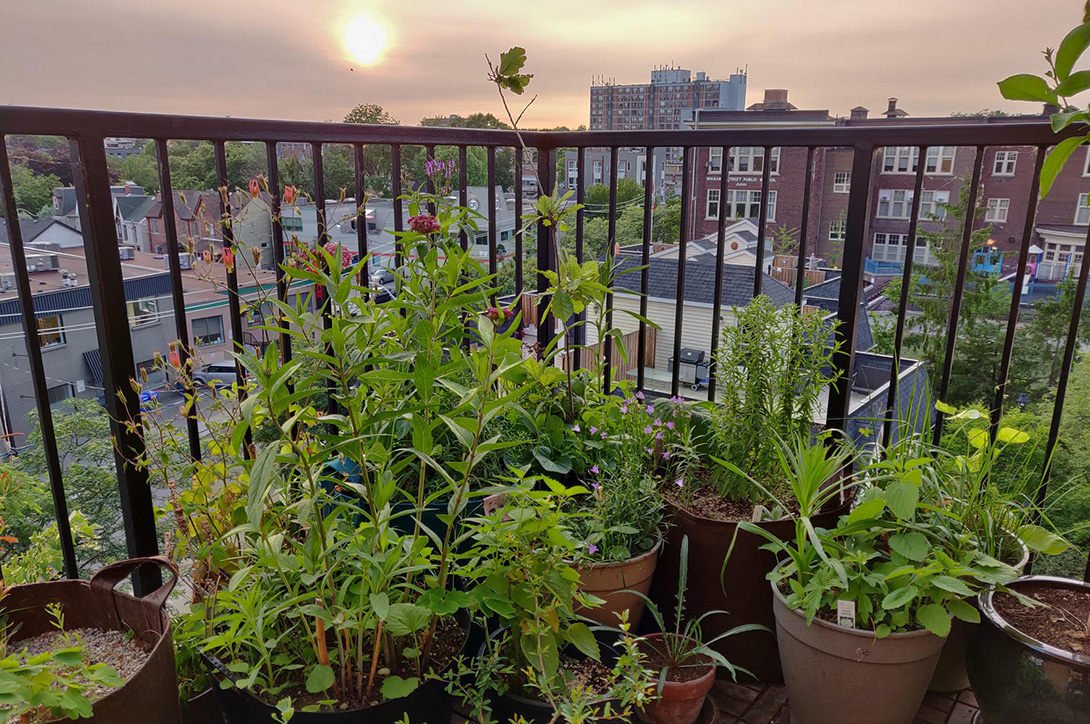
Freatured Image: Photo of Ryan Godfrey’s balcony garden in Toronto – WWF In the Zone