Gavin Hudson – Halton Master Gardener
May 15, 2026
Discover what these seven caterpillars will look like when they emerge as butterflies. Learn how to attract them to your garden with tips from Halton Master Gardeners.
In celebration of the 2026 Monarch Awards, we’re highlighting seven native Ontario butterflies and the plants that support them in your yard. The Monarch Awards celebrate and inspire eco-friendly gardening. Whether you’re just getting started or already building a healthy space for pollinators, birds, and other wildlife, your efforts matter. Find out how you can participate in the Monarch Awards, and don’t forget to make a spot in your garden for milkweed (Asclepias spp.)! Applications open for Hamilton residents on May 15 and close June 23, 2026.
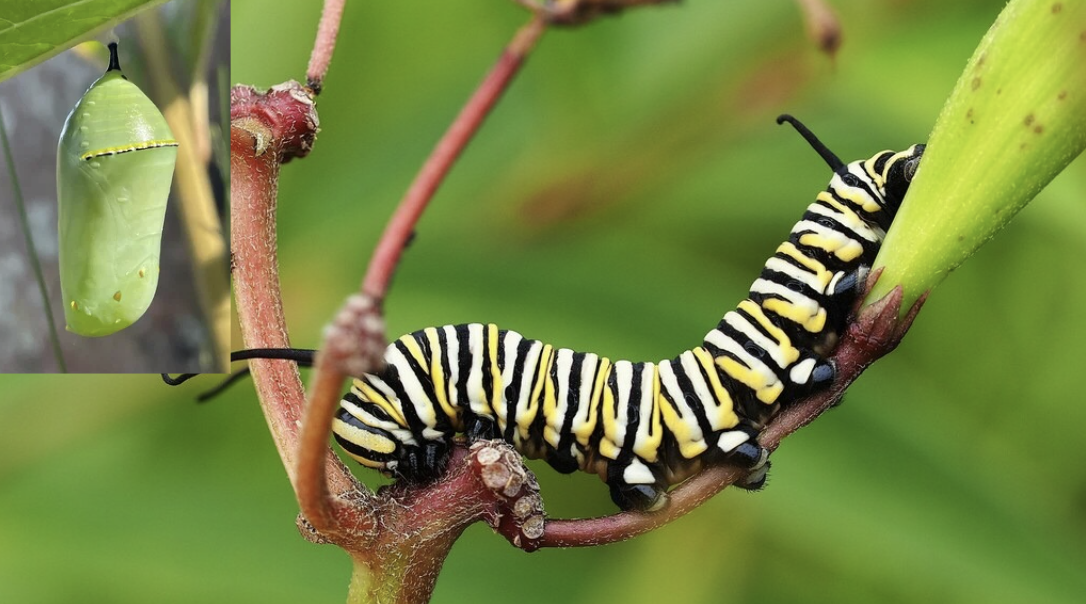
1. Monarch (Danaus plexippus)

Entomologist Samuel Hubbard Scudder named the monarch for its large size and because it “rules a vast domain” along its multi-generational migration route, a round-trip distance of about 10,000 kilometers.
As perhaps the most iconic butterfly in North America, monarchs feature prominently in human culture and stories, from Tommy DeNardo’s Ininiwizh & Memengwaa in Anishinaabemowin to Flight Behavior by Barbara Kingsolver in English to the Aztec belief that monarchs are the returning souls of the departed.
Adults can nectar on a number of plants, but milkweed is the only plant that caterpillars can eat. When the caterpillars hatch, eating the milkweed fills them with toxins, which make them less palatable to predators. Nonetheless, research suggests that fewer than 5% will survive to become butterflies. .To invite monarchs to your garden, plant the following:
- Milkweed (Asclepias spp.) boasts some of the most complex flowers in the plant kingdom. There are many milkweeds to choose from. Take a look at the Royal Botanical Gardens’ advice on types of milkweed to plant in Ontario.
- New England aster (Symphyotrichum novae-angliae) provides a late-summer nectar source for monarchs, painted ladies, and various swallowtail butterflies. They make a hardy addition to the garden, thriving in full sun and well-drained soil, but adapting to clay and as little as 3–4 hours of direct sun.
- Sweet Joe-Pye weed (Eutrochium purpureum) is a pollinator-friendly perennial in the aster family that also does well in full sun to partial shade, but prefers wet spots in the garden.
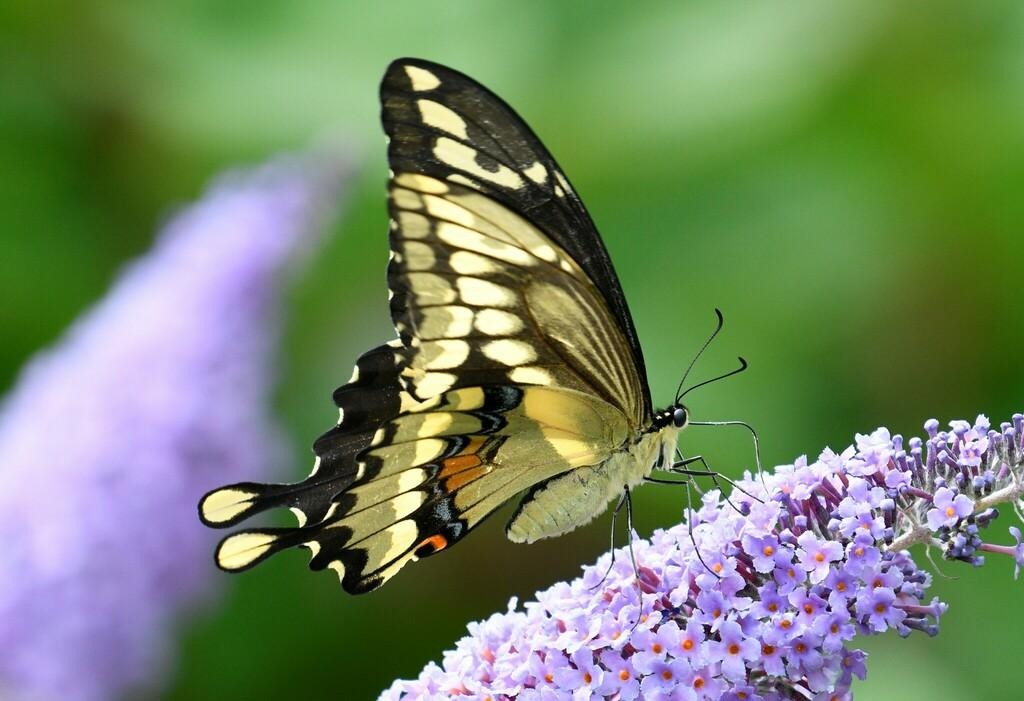
2. Eastern Giant Swallowtail (Papilio cresphontes)

Meet the real-life inspiration for the Pokémon Caterpie. The caterpillar forms a chrysalis that looks like nothing so much as a small bit of wood – perfect camouflage, especially on its native host trees. As a larva, if its bird-dropping camouflage isn’t enough to trick hungry cardinals, the eastern giant swallowtail has a secret defence lined up. In a flash, it goes from tasty treat to scary snake by extending its osmeterium, giving a very convincing impression of a snake tongue. Watch this in action. As an adult, this Caterpie cutie unfurls its wings as the largest butterfly in North America! Collect them in your garden with these native plants:
- North American azalea varieties are rhododendrons beloved by swallowtail butterflies and splash a rainbow of colours over your butterfly garden, depending on the variety.
- Hop tree (Ptelea trifoliata) is a primary host plant for eastern giant swallowtails. It does well in rocky, dry, well-drained, or nutrient-poor soils, and as a bonus its wafer-like fruits can even be used as a substitute for hops in home brewing*.
- Prickly ash (Zanthoxylum americanum) is a fragrant shrub or small tree, and another primary host plant for eastern giant swallowtails. Like the hop tree, it’s in the citrus family.
3. Painted Lady (Vanessa cardui)

Painted ladies live on every continent except (usually) South America and (less surprisingly) Antarctica. Like the monarch, their life cycle takes them on a multi-generational migration between Mexico and Canada.
In 2024, painted ladies were found outside their usual range in French Guiana, South America, with pollen grains from west Africa on their bodies. Researchers concluded they had flown an astonishing 4,200 kilometers across the Atlantic Ocean in just a week and possibly more than 7,000 kilometers in their lifetime. As if this weren’t incredible enough, radio records reveal painted ladies travelling twice this distance between Africa and the Arctic Circle, distinguishing them as one of the farthest-travelling insects on Earth.
They like sunflowers, thistles, and burdock, so you may find painted ladies on these sometimes prickly, often edible, and sometimes non-native plants. However, we do not recommend planting burdock, as it is invasive and its bristly seed heads can entangle and kill small birds and bats (Hager et al. 2009; Norquay et al. 2010). Painted ladies are not picky eaters — adults even drink the honeydew of aphids — making them easy to add to your garden’s invitation list.
- Pearly everlasting (Anaphalis margaritacea) was once popular in gardens and dried arrangements. It will attract several “ladies” to your garden, both painted ladies as well as American ladies (Vanessa virginiensis). It’s a shade-tolerant but highly adaptable garden plant that has also found a place among potherbs*.
- Jerusalem artichoke (Helianthus tuberosus) is an English mispronunciation of the Italian for sunflower, girasole, or “turning to the sun.” In the Haudenosaunee creation story, they grow from Sky Woman’s feet. In your garden, they will grow where there’s full sun and well-drained soil. They are prolific plants. To prevent their eager spread, place them behind wood or metal soil barriers at least 60 cm deep. Feed painted ladies and enjoy a bountiful harvest of the plant’s tubers.

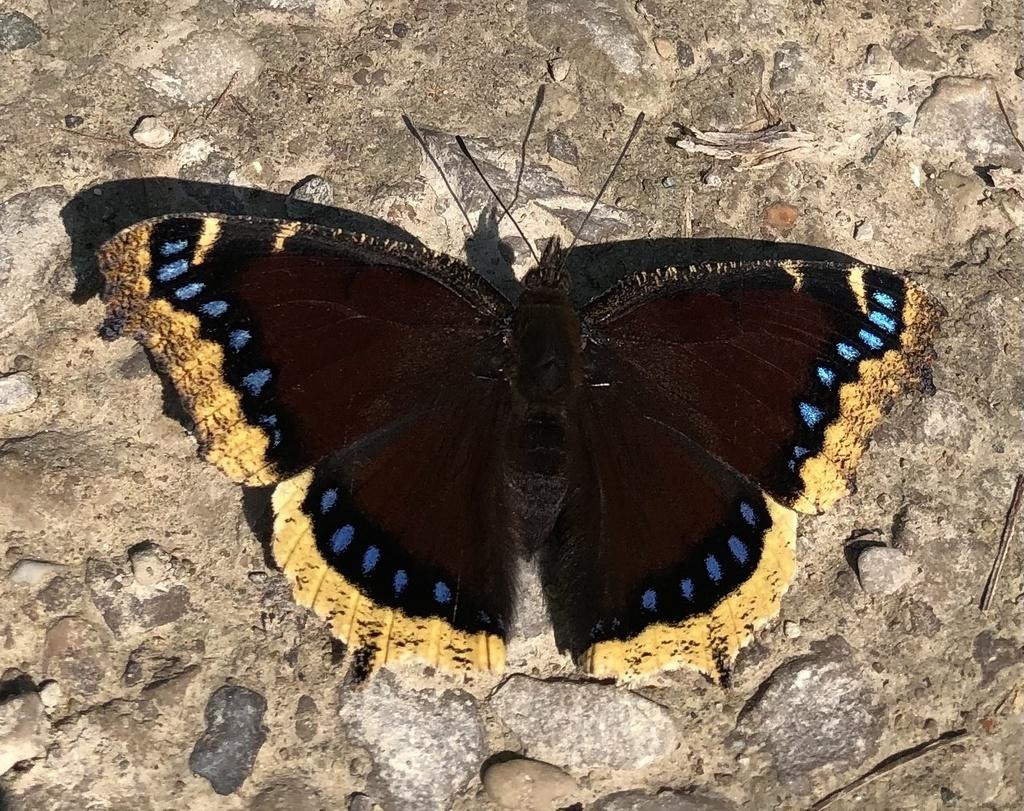
4. Mourning Cloak (Nymphalis antiopa)

The mourning cloak lives all around the Northern Hemisphere. The Japanese and Chinese name it for its bright “yellow-edge feathers.” The English know it as the Camberwell beauty. Carl Linnaeus named this butterfly after one of the several royal ladies of Greek mythology named Antiope and placed her in the genus of the nymphs.
If you’ve read German or Scandinavian fairytales, you probably won’t be surprised that, in these parts of the world, this beautiful butterfly has a darker backstory. They say the butterfly is wearing a dark cloak of mourning, hence the common English name in North America.
Mourning cloaks don’t migrate. Instead, they are among the very few butterflies that hibernate, allowing them to survive even Canadian winters in tree cavities or under loose bark. To attract this insect, make some room in your garden or nearby open spaces for one or more of the following plants:
- American elm (Ulmus americana), native to eastern North America and currently endangered, is so favoured by the mourning cloak that the larvae are sometimes called spiny elm caterpillars. Also called water elms, they like full sun and wet soil. If you’re concerned about Dutch elm disease and you aren’t opposed to “nativars,” look into cultivated native elm varieties with higher disease resistance.
- Slippery elm (Ulmus rubra) is a more common and slightly more disease-resistant tree. Whichever elm you choose, elm samaras* make great additions to salads and the elm’s inner bark has been used medicinally to treat sore throats and bowel issues*.
- Common hackberry (Celtis occidentalis) is a medium-to-large tree that can handle partial shade, clay, and limestone, making it well suited to southern Ontario. Give mourning cloaks and your family berries* to snack on with this exceptionally hardy, fast-growing tree.
- Hawthorns (Crataegus spp.) are better suited to a smaller, drier yard, growing as shrubs and small trees. Enjoy their edible and medicinal fruit* as well as their May flowers, resembling other rose or apple blossoms.
5. Silver-spotted Skipper (Epargyreus clarus)

Epargyreus clarus, the silver-spotted skipper, loves open gardens and fields. Females lay eggs singly, giving their offspring the ‘only-child’ advantage of inheriting an entire leaf to itself. Butterflies have special chemoreceptors enabling them to taste with their feet. Before laying an egg, the female silver-spotted skipper drums the leaf with her feet to ensure it will give her offspring the nutrients they need.
Unlike most butterflies, silver-spotted skippers overwinter as caterpillars (the larval stage) in sleeping bags of their own construction, wrapping one or more leaves around their bodies and insulating them with silk.
Encourage this stunning caterpillar and feed your soil in one swoop by planting legumes and some of the following Ontario native plants:
- Hopniss (Apios americana) has lovely purple flowers and small, edible tubers*.
- False indigo bush (Amorpha fruticosa) is a fast-growing perennial shrub that blossoms into pinks and purples. It prefers wet soil but can tolerate heavy clay.
- Ground bean (Amphicarpaea bracteata) grows well from full shade to full sun. It offers delicate bunches of small flowers as well as nutritious beans*.

6. Mottled Duskywing (Erynnis martialis)

The mottled duskywing is an endangered butterfly that has recently been documented in Burlington and Oakville. Males and females have specialized scent scales that carry pheromones to attract the opposite sex. Unlike most butterflies, they look for open patches among woodlands and lay eggs on two closely related plants.
Mottled duskywings are threatened by habitat loss and spraying BTK, a bacterium that indiscriminately kills many species of butterfly and moth larvae and is often purchased by cities, nurseries, and homeowners for spongy moth control. To help protect the last mottled duskywings, don’t spray lepidopteracides (butterfly- and moth-killing compounds), especially around plants that host mottled duskywings.
- New Jersey tea (Ceanothus americanus) is a drought-tolerant shrub with lovely white flowers that prefers full sun but will tolerate partial shade. As the name suggests, its leaves are also popular as a caffeine-free tea substitute*.
- Prairie redroot (Ceanothus herbaceus), found in endangered habitats, offers small clusters of white flowers to butterflies, hummingbirds, and bees.

7. Baltimore Checkerspot (Euphydryas phaeton)

Like silver-spotted skippers, but unlike most other caterpillars, the Baltimore checkerspot overwinters in home-spun webbing among the leaf litter. Unlike the silver-spotted skipper, Baltimore checkerspots hibernate communally. Their bodies contain antifreeze chemicals that allow them to partially freeze during the winter and thaw in the spring.
Baltimore checkerspots look for milkweed, like monarchs. They’ve also adapted to eat non-native plantains that grow in urban lawns and disturbed soils. Native planting options include:
- White turtlehead (Chelone glabra) is a charming, white-flowering plant well suited to low-lying, wetter areas and rain gardens. It’s the main plant Baltimore checkerspots seek out when it comes time to lay eggs.
- Black-eyed Susan (Rudbeckia hirta) is a cheery yellow coneflower in the family of asters, daisies, and sunflowers. It grows in clusters and has traditional medicinal uses for the treatment of colds*.
- Mountain mint (Pycnanthemum spp.) attracts bees, butterflies, and people with its pleasant smell and taste. It’s a less aggressive garden member than some of its non-native relatives, making it a better match for most sunny gardens.

Gardening for Butterflies and Biodiversity

We hope you’ll consider planting some of these butterfly-friendly native species in your garden. If you live in the Hamilton area, apply to the Monarch Awards, no matter what stage you’ve reached in your gardening journey. Open to everyone in Hamilton, Ancaster, Dundas, Flamborough, Glanbrook, and Stoney Creek, its mission is to educate, inspire, and acknowledge gardeners who create sustainable gardens that provide shelter, nesting sites, and food sources for native flora and fauna.
Pollinator-friendly plants support more than butterflies. Did you know there are around 400 species of native bees in Ontario? These heroic pollinators are struggling right now to feed themselves as fields and farmlands are converted into roads and residential or commercial real estate. Your pollinator garden will feed them.
Perhaps your garden will attract the hummingbird hawk-moth, a real-life chimera that will leave you wondering whether you’ve seen a bird or a butterfly. Neither. In fact, it’s a kind of sphinx moth. Or perhaps the alien-looking flowers of your wild ginger, pollinated by beetles, will inspire you to go beetling in your backyard, a favourite pastime of Charles Darwin.
No matter what species come calling, gardening is an important way to constructively participate in your home ecosystem. Transforming your yard from standard sod to fantastic flowers is a journey mirrored in the metamorphoses of the butterflies who make your garden their home.
Special thanks to Halton Master Gardeners Janet Hughes-Mackey and Grant Linney for contributions to this article.
*This article is shared for educational interest only and is not medical advice. Proper identification of wild plants is essential, as some plants can be harmful or toxic if misidentified. Always consult a qualified healthcare professional or experienced expert in identification before consuming or using any foraged plant.